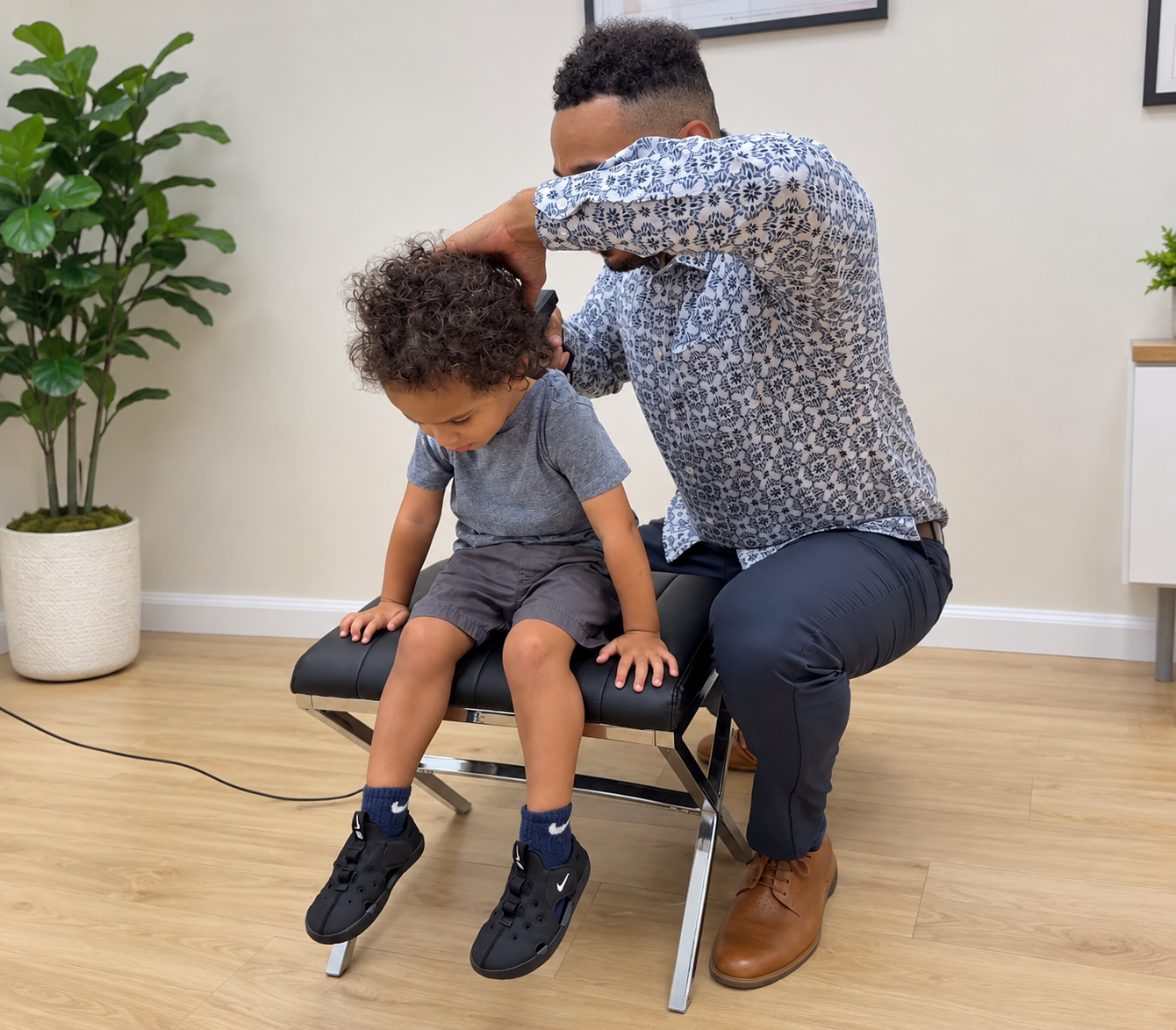

West Ashley and other Lowcountry parents are searching for pediatric chiropractic more than ever, whether the goal is easing a fussy infant, helping a stiff neck straighten out, or just giving a cranky toddler some relief. At Thrive Spinal Care in Charleston, Dr. Terence Hoff treats children with the same upper cervical, specific approach he uses with adults: a precise focus on the top two vertebrae, adapted with a fraction of the pressure for a child’s developing spine. Here’s what that looks like, what it may help with, and where the research actually stands.
What a pediatric adjustment looks like
Nothing like what most parents picture. Dr. Hoff’s upper cervical technique already uses far less force than a full-spine adjustment, and on an infant that pressure drops again, down to roughly what you’d use to check a tomato for ripeness. No cracking, no twisting, no popping sound. He’s checking whether the atlas and axis, the two vertebrae that cradle the brainstem, are sitting where they should after the trip through the birth canal, a long labor, a vacuum delivery, or months of a newborn always turning her head the same direction in the crib.
How pediatric chiropractic care may support your child
Charleston-area families bring their kids to Thrive Spinal Care for a range of reasons, and the evidence behind each one varies quite a bit.
Colicky and fussy babies
This is the condition parents ask about most, and it’s also where the research has the most to say. A widely cited Cochrane review of six trials found infants receiving manipulative therapy, including chiropractic, cried about an hour and twelve minutes less per day than infants who didn’t, and a 2025 review in Clinical Pediatrics found several newer studies reporting that same kind of reduction. Families who try it for colic consistently describe real relief. One nuance worth knowing: in the two best-controlled trials, the ones where parents didn’t know which treatment their baby had received, the effect was smaller and didn’t reach statistical significance, which suggests some of what gets measured is parental attention and hope working alongside any physical effect. No provider can promise a specific result, but the direction of the evidence is genuinely encouraging.
Torticollis and tummy-time tension
Infants who consistently turn their head one direction, whether from birth positioning or simply habit, can develop tight neck muscles and a tilted head, sometimes alongside a flat spot from car seat and carrier time. This is squarely musculoskeletal, and gentle manual therapy for it is easier to study and less prone to the placebo effect that muddies colic research.
Sleep
Parents frequently report better sleep after starting care, though this overlaps heavily with the colic evidence above. Less crying and tension tends to mean more sleep for everyone in the house, including the parents.
Posture as kids grow
Charleston’s Lowcountry lifestyle means car rides on 17 and I-526, hours of tablet time, and heavy backpacks, all of which strain a developing neck and spine the same way they do to an adult. This is where upper cervical care has its strongest evidence base, since it’s a direct, measurable structural issue rather than a systemic one.
Immune system and overall wellness
This is where the science gets genuinely interesting. The nervous system and immune system are directly linked, a relationship well established in mainstream neuroscience through pathways like the vagus nerve, which helps the body regulate inflammation and infection response. Chiropractic-specific research backs this up. A 2022 multicenter study found that a single upper cervical adjustment raised salivary IgA, the antibody that guards your mucous membranes against cold and flu viruses, by nearly 38 percent within 30 minutes. It’s not a guarantee, and researchers want to see that finding replicated in a larger, controlled trial, but it’s real, peer-reviewed evidence that an adjustment does more than relieve tension.
On safety
Serious complications from pediatric spinal manipulation are rare. A frequently cited systematic review in Pediatrics found that reported serious adverse events almost always trace back to non-specific, high-velocity techniques or missed diagnoses, not the light, targeted approach an upper cervical-trained provider uses on an infant or child. Still, the pediatric safety research base is thinner than anyone would like, so ask any provider, Dr. Hoff included, about their specific training in evaluating and adjusting children before you book.
Quick answers for Charleston parents
Is it safe to take a newborn to a chiropractor? Generally, yes when the provider is trained specifically in pediatric evaluation and uses age-appropriate, low-force technique. Reported serious complications are rare and mostly tied to non-specific manipulation rather than the gentle, targeted approach used on infants.
How is pediatric chiropractic different from adult chiropractic? The evaluation and pressure are both scaled down substantially. There’s no forceful twisting or the audible pop associated with adult adjustments. It’s closer to light, sustained contact than manipulation in the traditional sense.
Is Pediatric Chiropractic Right for Your Family?
Pediatric chiropractic is a gentle, low-risk option that plenty of West Ashley and Charleston families find genuinely helpful, for colic, torticollis, sleep, and posture, especially alongside your pediatrician’s care rather than in place of it. The research behind some of these benefits is still developing, and any provider who guarantees an outcome is overselling it. If you’re curious whether it’s worth trying for your family, that’s a conversation worth having.
Dr. Hoff offers evaluations for infants and children at Thrive Spinal Care in West Ashley, serving families across Charleston and the Lowcountry. Contact us today to see how we can support your child’s health.